I remained pain-free for about one week before my tummy’s protein-fluid started returning. The excruciating pain caused by the fluid on my old wound returned as well. This time round, I resorted to using surgical tape to "stitch" the old wound superficially so that they would there will be less pressure tearing at the old wound and this simple method does reduce the pain. I thanked God for whatever relief I received.
At the same time, my back pain which wasn't a concern for me during one-week relief from tummy’s bloatedness has also returned. I had to resume my morphine drug to manage the pain again. I was scheduled for another CT scan at NCC on 19 Oct'11. The scan as originally scheduled 28 Oct, but due to my insistence, my oncologist managed to secure an earlier slot for me. He later disclosed to me that it was due to the fact that he donated $10k to the NCC Cancer Fund, and his close working relationship with NCC that I was given an earlier timeslot. I was so touched when I knew the extra miles my oncologist walked for me, but he also thought that he was donating for a worthwhile cause. I thanked God again for being treated by a doctor with moral conviction.
The CT scan revealed further spread of my tumours in both the peritoneal cavity and in my liver. My oncologist shared with me that he had run out of option and suggested me to stop all my chemotherapy treatment. I took his advice, and the HCA hospice care will be acting as an intermediary between me and my oncologist. In the meanwhile, I am given mild dosage of morphine to manage my pain, am followed up regularly by hospice nurse and doctor, and learning to spend the remaining time with my loved ones meaningfully.
If you could join me in prayer, please pray that:
1) I could have the appetite to enjoy food, and to appreciate the newness of each day together with my loved ones. I am vomiting on a daily basis and losing weight;
2) I give thanks to all forms of support I have received in the past many months. Many of you have been walking with me through prayer support, some through monetary pledges, some through SMS text, some through emails, some brought fruits for me, etc. I appreciated whatever forms of support I have received. Please continue to walk with me, and I believe God will bless you in many ways than I know of. Pardon me if I may not respond as much as I would to in future due to my declining health, and for my need for extensive rest.
3) Though I do not know how much time I am left with, I ask for trust in God's goodness, in God's faithfulness, and to find continual rest in the peace and joy that can only brought about by an eternal relationship with the One above, and the One within;
4) The last one may not be that related to those above, but has been on my mind for some time. Even as the cost of living keeps increasing in Singaore, may the policy of the government work for the benefits of the poor and marginal. May God particularly remember those who are sick and poor among us.
May God's peace and blessings be upon you.
3 Nov’11
Thursday, November 03, 2011


When we cannot solve problems of those we seek to help
I would like to share two paragraphs from Henri Nouwen's Spiritual Direction: Wisdom for the long walk of faith, an extract on "what to do" when we cannot solve problems of those we seek to help. More often than not, I have heard Christians utter the magical word "Trust in Jesus Christ" or "Believe in God" to signal the end of a brief conversation (or perhaps the "exit" sign) with the other who is experiencing real pains and sufferings. These were the typical responses I chose initially as a chaplain intern, as I was frozen by fear of not knowing what to say; later I experienced it on a different level as a cancer patient. However, as a cancer patient, these responses sound like cheapening the grace of God, of distrusting the reality of God's presence and of not having experienced the empowerment of His church. Later, I learned to stand in solidarity with the patient by listening attentively, by giving my full presence to the patient. It is not so much about what to say anymore. My suggestion to all who are learning to minister to others in pain: Stand in solidarity with the sufferer, even when you can't solve the problem. It is even all right to cry with the sufferer. Your presence embodies Christ. Below are two paragraphs which are helpful to me one reaching out to minister to others, from Henri Nouwen’s Spiritual Direction:
WHEN WE CANNOT SOLVE PROBLEMS OF THOSE WE SEEK TO HELP
But what if we cannot solve the problems or change the circumstances of those we seek to help? Alleviating pain and suffering may sometimes be the fruit of our being with those who suffer, but that is not primarily why we are there. Ministry takes courage to be with the sick, the dying, and the poor in their weakness and in our powerlessness. We can't fix their problems or even answer their questions. We dare to be with others in mutual vulnerability and ministry precisely because God is a God who suffers with us and calls us to gratitude and compassion in the midst of pain. You cannot solve all the world's problems, but you can be with people in their problems and questions with your simple presence, trusting that joy also will be found there. As Mother Teresa was fond of saying, "Jesus does not call you to be successful, but to be faithful."
Jesus said, "Be compassionate as your heavenly Father is compassionate." It's a great calling. Don't be afraid. Don't say, "I can't do that." When you know yourself to be the beloved, and when you have friends around you with whom you live in community, you can do anything. You're not afraid anymore to knock on the door while someone is dying. You're not afraid to open a discussion with a person who beneath the glitter is much in need of ministry. Knowing that you are loved allows you to go into this world and touch people, heal them, speak with them, and make them aware that they are beloved, chosen, and blessed. Not by our might or by our power but by our simple presence in the midst of suffering, we show our love and gratitude for others. This is the mystery of ministry.
Henri Nouwen, Spiritual Direction: Wisdom for the long walk of faith. New York, NY: HarperCollins Publishers, 2006. pp.136-37.
WHEN WE CANNOT SOLVE PROBLEMS OF THOSE WE SEEK TO HELP
But what if we cannot solve the problems or change the circumstances of those we seek to help? Alleviating pain and suffering may sometimes be the fruit of our being with those who suffer, but that is not primarily why we are there. Ministry takes courage to be with the sick, the dying, and the poor in their weakness and in our powerlessness. We can't fix their problems or even answer their questions. We dare to be with others in mutual vulnerability and ministry precisely because God is a God who suffers with us and calls us to gratitude and compassion in the midst of pain. You cannot solve all the world's problems, but you can be with people in their problems and questions with your simple presence, trusting that joy also will be found there. As Mother Teresa was fond of saying, "Jesus does not call you to be successful, but to be faithful."
Jesus said, "Be compassionate as your heavenly Father is compassionate." It's a great calling. Don't be afraid. Don't say, "I can't do that." When you know yourself to be the beloved, and when you have friends around you with whom you live in community, you can do anything. You're not afraid anymore to knock on the door while someone is dying. You're not afraid to open a discussion with a person who beneath the glitter is much in need of ministry. Knowing that you are loved allows you to go into this world and touch people, heal them, speak with them, and make them aware that they are beloved, chosen, and blessed. Not by our might or by our power but by our simple presence in the midst of suffering, we show our love and gratitude for others. This is the mystery of ministry.
Henri Nouwen, Spiritual Direction: Wisdom for the long walk of faith. New York, NY: HarperCollins Publishers, 2006. pp.136-37.
Tuesday, October 18, 2011
An unfinished journey
In one of my last few academic theological papers, I had to evaluate Paul Knitter’s typology: replacement, fulfillment, mutuality, and acceptance as a framework for inter-faith dialogue in his Introducing Theologies of Religion. On top of that, our class had to analyze why we prefer a certain model or a framework for inter-faith dialogue. This model or framework could be a modified form of the existing one or one of the current existing one. Towards the end of my paper, I suggest what is the responsibility of a Christian theologian in inter-faith dialogue, and what marks a true inter-faith dialogue, and hopefully to probe for possible development in the near future regarding inter-faith dialogue. However, I don’t think I can continue along that line of academic development anymore, so I shall call it an unfinished journey. Allow me to share an extract from my paper,
I believe my responsibility as a Christian theologian is to confess my faith, and to invite others to experience the liberating relationship with God. The act of confession and invitation necessarily entails the art of listening and being instructed by others, as well as to practice the act of compassion towards people of different faiths. I would suggest that the ethical-practical bridge component in the mutuality model is a must for mutual dialogue. By crossing the ethical-practical bridge, I am challenged to accept the value and dignity of human life regardless of other faith commitment. I am called to recognize the presence and work of the Spirit of the Trinity among others, and to work for the exaltation of human's freedom from despair and social injustice. This implies that in inter-religious dialogue, I must recognize the radical differences of other religions, and allow their rich complexities to speak to me by not imposing my question of salvation on them. I must allow them to be who they are in order for them to speak to me, and to confess my own ignorance while seeking to learn from them. My above argument spells out why partial-replacement model may not be preferred and why the fulfillment model and the Heim’s proposal are more compatible with the root-metaphor of the kingdom of God and more conjugal to grids that provide natural habitat for extension of thought, and linkages beyond the immediate horizon.
I believe that the God whom we have a relationship with cannot not be held captive to any religion, nor be contained within any doctrines or propositions. To be in a relationship with the triune God we come to know in Christ is to be set free to know, to love, to serve and to live in submission to the authority of Jesus Christ the head of the paradigm community whom we called the church.
(An extract from Swee-Leong Koh’s final paper, in fulfillment of the academic requirement of Dr. John Berthrong’s class Theologies of Dialogue, Fall 2009)
Now that I am a cancer patient, I am called once again to ponder my relationship with the God who is not contained within any doctrines, I am called once again to re-experience the God who is Love despite of all the physical ailments I am going through. It is no longer an academic contemplation about who God is, but a call to experience God despite the failings of my physical body. I am getting thinner and I am trying hard to regain weight; I had my tummy fluid extracted last week but the fluid is returning, so has the “sharp pains”. I am learning to trust my life into God’s hands and trying to learn how to rejoice at whatever relief that can be found. My journey towards inter-faith dialogue may not be fulfilled, while my new journey continues to mark new milestone for me; and I ask God to be extremely merciful in my new journey which will probably see me passing on into the next life.
Sunday, October 16, 2011
A minor surgery to drain out 3-litter of fluid from my tummy
I had a minor surgery on 11 Oct’11, to draw out out the excess fluid floating in my stomach. The excess fluid was pressing my liver against my chest and it could be so painful that I felt a knife piercing through the bottom of my left ribcage whenever I exerted strength to switch from a flat to sitting position or when I laid in a flat position. This made sleeping at night for consecutive few hours near impossible, particularly during the last one week. As the pain became more frequent, I felt more and more miserable. I thank God that 11 Oct was my consultation as I was near the point of breaking down.
The whole surgery lasted about two hours. Ten minutes to prepare for the needle to go in, five minutes to withdraw the needle and the rest of the time to drain out the excess fluid. A total of 3-litter was drained from my stomach. Fluid which had been accumulated in the last few months and causing me the feeling of "bloatedness" in the tummy and the "knife sharp pain" near the left lung was finally been drawn out. The draining was quite painless except that I felt uncomfortable laying in a confined space, and I experienced gastric reflux twice as I did not have any food throughout the whole afternoon. During the span of two hours, I was also given albumin injection to make up for the one I had lost, and a separate chemotherapy injection to save time.
Towards the end of the surgery, as I watched the 3-litter of bloody-fluid in a inflatable bag, I heaved a sigh of relief but at the same time, I wanted to burst out in tears. I felt like I had gone through so much. I had gone through one episode of pain endurance followed by another. When would it end? I long to enter an eternal rest where there is finally no suffering, no sorrow, and enjoying the intimate fellowship of our Trinity God with our fellow brothers and sisters who had passed on.
As I was reading Henri Nouwen's The return of the prodigal son: a story of homecoming (First Image Book, 1994, p.96), a paragraph spoke to me:
In Latin, to bless is benedicere, which means literally: saying good things. The Father wants to say, more with his touch than with his voice, good things of his children. He has no desire to punish them. They have already been punished excessively by their own inner or outer waywardness. The Father wants simply to let them know that the love they have searched for in such distorted ways has been, is, and always will be there for them. The Father wants to say, more with his hands than with his mouth: ‘‘You are my Beloved, on you my favor rests.” He is the shepherd, “feeding his flock, gathering lambs in his arms, holding them against his breast."
Nouwen has helped me to understand that despite the pains I am going through, I am a beloved child of God, and His love is always here to be found as it is it always present. Our God is a suffering God and God knows the depth of our experience because God walks with us in our journey. This thought brought peace to my mind once again and I would like to share my prayer concern:
1) I thank God for the success of my minor surgery. I was totally exhausted after my surgery, and I am still trying to regain strength. I don't know when fluid will build up till I have to go for surgery again, but I ask for the ability to enjoy life no matter how bad my condition will be (have mercy on me, oh Lord);
2) I am due for another CT scan again. I don't know what the outcome will be. If the tumours are shrinking or are under control, I will be delighted. But if the tumours are spreading, what are the alternatives for me? Fear lurks in the corner of my mind. I pray for my tumours to shrink and may God guide me through this valley of fear. May God allow me to feel His touch and to hear His voice;
3) I continue to ask for good appetite. I have been vomiting almost daily and I am losing weight, which is not a good news for any cancer patient. I ask for the wisdom to plan my diet and rest so that my stomach will not go hungry nor will it consume excess food. I need to take in more food to gain weight;
4) I continue to ask for quality time with my family members, and I ask for God's blessings upon them.
Thanks for being my praying partners. May God's blessings be upon you as well.
Wednesday, September 28, 2011
Hospitalized for feet’s bacterial infection: part 2 of 2
The first night after the acupuncture was terrible. I had to position my feet in a baby bathtub while laying on the bed the whole night. I hardly slept well. I felt my feet to be less swollen in the next two to three days. However, whenever I planned to move about, my feet had to be wrapped in tissue papers and plastic bags by my wife or my mother. It was very inconvenient, but at least I felt less resistance in moving my feet. The redness above my feet started to be more noticeable. Four days after acupuncture, the fluid drip had decreased dramatically but I was experiencing increasing pain whenever I moved. By the evening, I could not move my left feet was it was so red and swollen. I started rallying for prayer support. On the 8 Sep’11, I could hardly walked as my left foot was too painful. My wife called the TCM practitioner. His first question was whether we would like to have another house visit consultation, and we said no. He next said that I was his first patient to suffer from red swollen feet after five days of acupuncture. I had a gut feeling he did not know it was a case of bacterial infection. This would be the last time I would use his service, and I am still undecided whether to write a letter of complain to the TCM board in Singapore.
Thank God, I was visited by my hospice doctor and nurse on 8 Sep’11 who identified my condition as bacterial infection. Dr. Kee prescribed an antibiotic, Augmentin, for me, but I vomited it out two hours after consumption; and it happened twice. As I could no longer tolerate my bacterial infection, I discussed with my wife and mother the idea of hospitalization on the morning of 9 Sep’11 before consulting with Dr. Tay at Gleneagles Hospital whether it was possible to make such arrangement. He expedited the process and by afternoon, there was a bed vacancy for me in a four-bedded ward. As I was not scheduled for operation, I was allowed to wear my home clothing in the ward. Compared to Singapore General Hospital (SGH) where I had my radical nephrectomy, my dress code as a patient made me felt faceless as I was identical with other patients wearing the same hospital gown. What’s more, the nurses at SGH preferred the curtains separating each bed to be opened at all times so that nurses at the door could see what was happening at one glance. There was a loss of privacy. At Gleneagles, the curtains between beds were drawn all the time to maintain privacy.
The first night at Gleneagles, I was injected with liquid Augmentin to ensure the antibiotic traveled to the infected site immediately instead of passing through the digestive system. Every morning and evening, I had an antibiotic injection. I had another liquid diuretics injection to ease the swelling of my legs. Most of the time, my legs were propped up on pillows to facilitate blood circulation in my feet. In this ward, four patients were entitled to two toilets which included the shower room, unlike the ward I was in at SGH last year, five patients were entitled to one shower room and a separate toilet. Comparatively speaking, it was more comfortable recuperating at Gleneagles. The funny thing was when I was introduced by Dr. Tay to his colleague and the nurses on shift, I was known as “a church co-worker who has no money”.
With each passing day, my swelling eased. I was able to walk slowly though it was still painful to exert pressure on my left foot. By the 3rd day of admission, I was given the option to discharge. However, the doctor in-charge of me preferred to to stay for one more day to monitor my situation and for additional doses of antibiotic. Since I could walk without much assistance, I tried to stand up on my own and walked to the toilet myself. Each successful attempt was a cause for celebration. In the initial two days when I had to rely on the wheelchair and my wife to push me, I had to use urinal to pass urine which felt awkward.
I was officially discharged on the 12th Sep’11 and still had to depend on wheelchair to move about. I was given one week of penicillin to manage the bacterial infection. When I was about to reach home, I did not particularly enjoy the stare of a lady in her fifties on the first floor of house elevator as if I were an alien or someone who looked like a possible source of her gossip. I also did not like the stare of my speechless neighbour that made me wish I were invisible. I still depended on wheelchair for movement during the first few days, and subsequently, I could finally move about more independently. The skin which was originally red and swollen became to come off and I had to apply intensive moisturizer often to ease the discomfort. Now, slightly more than two weeks after my discharge, I could say most of my ordeals with bacterial infection is almost over, and I thank God and God’s community of people for walking together with me. I felt God has been with me throughout this trial, and I was greatly comforted by my friends who have been lifting me up in their prayers. My wife and mother have also been taking very good care of me during this period of trial.
Now, I have to cope mainly with bloating tummy which my oncologist suggests is due to leaky blood vessels which will be alleviated by my chemo drug, Avastin. My sleep has also become irregular. I could at most catch a few hours of sleep before waking up again, and a few hours later on. My appetite has also shrunk, and I could only take frequent, small meal everyday to satisfy my hunger. I have to be careful with my diet because if I overate, I am almost certain to throw up.
How right is the advice of the Teacher when he says “Rejoice, young man, while you are young, and let your heart cheer you in the days of your youth. Follow the inclination of your heart and the desire of your eyes, but know that for all these things God will bring you into judgment.” (Ec 11:9) Enjoy while we still can, because there will be a day when our body cannot enjoy the pleasure of good food and the comfort of life anymore. Yet, in the process of enjoyment, we are to remember that God will take into account how we live our life.
Hospitalized for feet’s bacterial infection: part 1 of 2
It started with edema in the mid of August when I noticed my right foot to be swollen after teaching adult Christian education class one Sat morning. The swelling of both my feet coupled with increasing tiredness were telltale sign of the ineffectiveness of my 2nd chemo drug, Affinitor. After I stepped down from my teaching post at Jubilee School of Missions and the Peoples’ Presbyterian Church, and the Bible leader role from Providence Presbyterian Church at Jurong, I was able to rest more often, and had more time for reading. However, my edema became more serious towards the end of August. Propping the legs above the heart level every night was the only advice I had to from my oncologist to ease the swelling. I also noticed that my stomach had become bloated as well. I was told that my stomach was retaining water by my oncologist; because it was not serious enough, it was not a cause for concern yet. Dr. Kee from HCA hospice care advised me to take in highly nutritious milk as my main food intake to make up for insufficient protein intake. He asked me whether I would like to try diuretics to ease the edema, and I guess I was not ready to for new medication yet. However, I bought more packets of ready-made milkshake for cancer patient to supplement my protein intake.
By the end of August, the swelling in both legs had aggravated. I could only rest my feet on a higher support every now and then during the day to reduce the swell. At night, apart from wearing compression socks, and resting them on a pillow, there was nothing much I could do. The swell were usually less obtrusive in the day, and aggravated towards the evening. I had difficultly walking and felt clumsy in my movement. My mother borrowed a wheelchair and waling frame on my behalf to facilitate my movement at home. During my consultation with my oncologist on 23 Aug’11, I had to be wheeled in the hospital.
Finally, someone whom I am close to informed me of a registered practitioner in traditional Chinese medicine who is experienced in reducing water retention. His clinic is located at Upper Bukit Timah Road. After much hesitation, I decided to give it a try. The practitioner offers home consultation for a much higher fee than clinical visit, but since I had difficulty traveling, I asked him to come to my place. On 3 Sep’11 evening, he and his wife arrived and explained to me what he was going to do. He illustrated few examples of his success cases where his patients were relieved of their edema. According to him, my body could not absorb the excess nutrients and these had to be released. He commented that unlike the Western doctors who focused on draining off of fluids, his technique will in fact help the body to be strengthened eventually through acupuncture. He cited an example of his elder brother who was supposed to undergo surgery to remove his remaining kidney, but with two-year acupuncture treatment his elder brother’s kidney function was restored and was spared from the nightmare. He assured me that his technique will boost my overall immune system.
After heating his needle, which I assumed was his method of sterilization, and applying alcohol on my stomach and my feet, he started poking from my head, then to my feet where my mother, my wife, myself witnessed fluid oozing out from the acupuncture points. I felt a sense of relief as I thought I did not have to cope with edema much longer. Then the practitioner’s wife reminded him to poke my stomach. Fortunately, no fluid came out from my stomach. I was next given a used bottle of aloe vera cream to accelerate healing of the skin. What I did not know then was the beginning of bacterial infection for me. I was only told to wash my feet with clean water, to use toilet roll and towels to absorb outflowing fluid, and if fluid outflow was heavy, to use sanitary pad to wrap it. There was no sterilizing gauze or anti-bacterial solution in his concept. I was told not to use soap during bathing in the next few days, which I obediently followed. I was mentally prepared to expect heavy fluid outflow from both feet in the coming one to two days, and subsequent decreased in fluid flow three to five days after. The TCM practitioner left twenty minutes after his arrival, with a hefty sum of fee.
Sunday, September 25, 2011
Moving from 1st to 4th line of treatment within two months
I started switching to Affinitor in the early July when my CT scan done on 28 Jun’11 revealed the ineffectiveness of Sutent (my 1st line of treatment) in managing my tumours. I decided to switch to another oncologist, Dr. Tay, at Gleneagles for 2nd opinion and for more personal advice. Dr. Tay was of the opinion I should also switch medication and knowing my situation, he was able to offer me a cheaper price for the same medication. After trying out for two months, it was clear from my 17 Aug’11 CT scan that Affinitor was not working for me either. Dr. Tay suggested me to switch to 3rd line of treatment, another oral anti-angiogenesis drug Votrient. By then my energy level was declining, and I was coping with the after-effect of radiotherapy.
My blood test result two weeks after I took Votrient revealed that this drug might be ineffective as well and my energy level was declining steadily. During that two weeks interval, I had asked my family members to be mentally prepared in case my health continued to spiral downwards. My sudden loss of weight after one week of radiotherapy from 18-25 Jul‘11 to kill tumours growing on my spinal cord did much damage to my body. Though each therapy session lasted for last than five minutes, and it was painless, I vomited on a daily basis then and ate little during that brief one week of treatment. I didn’t gained any weight since then, except experiencing edema. The therapy also left a burnt mark on my back.
By end of August, my feet were so swollen and I felt so weak that I had to use a wheelchair when consulting my oncologist at his clinic in Gleneagles hospital on 23 Aug’11. My 17 Aug’11 CT scan did not look good, and my blood test did not look good either. Tumours have grown back on my spinal cord, and I am taking oral morphine to manage my pain. When Dr. Tay asked me how I felt about the my own condition, and I remembered saying “Not positive”. He advised me to be mentally prepared. I was given the option to stop treatment or to try the 4th line of treatment, using intravenous injection drug, Avastin. I heard of Avastin before, and it was the drug approved prior to Sutent by the US Food and Drug Administration, but a more expensive drug than Sutent. I would like to try everything within my means before giving up so I decided to give it a go. Dr. Tay also arranged the service of HCA Hospice Care for me.
I started Avastin on 23 Aug’11 and it has been a month. I believe my body is responding to Avastin as I did not feel my energy level to be dipping further and my blood test on 9 Sep’11 indicated that my liver’s and kidney’s function to be improving. I thank God for the extra time I have with my family members now. Dr. Kee, the hospice doctor, suggested that any extra day for me is an added bonus. Dr. Kee’s suggestion is a new paradigm for me. Each day is indeed a day of gratitude, though I have to cope with occasional swollen feet and bloated stomach now.
Friday, September 23, 2011
Stating my philosophy of life briefly
I have been asked whether life is meaningful if one were to die eventually. I would say a definite YES. I believe we live to create good memories with our cherished ones, and we leave behind memories while also taking it together with us. Grief is a natural process of detachment. Everyone is bound to attachments which will be naturally followed by detachments. The challenge is to live in the present NOW, because what exists is NOW. The deeper challenge is to create good memories for oneself and for others in the present NOW, knowing that we will be held accountable for how we lived (that is the last word of Ecclesiastes by the way). To refuse to let go of detachment is to trap oneself in a spiral of grief. I know this sounds a bit like Buddhism, but what makes this belief different is the assumption that the reality we construct now is a shadow of the perfect one that is to come, and will come. Paul says in Eph 1:13-14 "And you also were included in Christ when you heard the message of truth, the gospel of your salvation. When you believed, you were marked in him with a seal, the promised Holy Spirit, who is a deposit guaranteeing our inheritance until the redemption of those who are God’s possession." Since we have received the Holy Spirit, what God says will happen will definitely take place. "Meaningfulness" is dependent on God's promises while living in the present reality.
Saturday, September 17, 2011
Community requires forgiveness by Henri Nouwen
There are different types of community life you have probably been part
of. There are probably some where you enjoy and you feel like part of
its whole. There might also be some where you wish some of the
underlying problems could be resolved before the community moves on.
There might be a few where hurts and grievances are not given room
to be expressed and healing is not taking place. Instead, these hurts and pains are hidden, and allowed to corrupt the goodness of the community unconsciously. Depending on the culture and source of authority within the community, some deem it a disgrace to air grievances, while some simply re-interpret the experience and put the source of blame squarely on those who are suffering. Some simply lack the experience and skill to handle hurt and grievance, and choose to ignore it. Recently, I come across Henri Nouwen’s Spiritual Direction: Wisdom for the long walk of faith. There is a part on forgiveness within community that I would like to share with you, titled “Community requires forgiveness”.
COMMUNITY REQUIRES FORGIVENESS
Within the discipline of life in community are the twin gifts of forgiveness and celebration that need to be opened and used regularly. What is forgiveness? Forgiveness means that I continually am willing to forgive the other person for not fulfilling all my needs and desires. Forgiveness says, "I know you love me, but you don’t have to love me unconditionally, because only God can do that." I too must ask forgiveness for not being able to fulfill other peoples total needs, for no human being can do that.
We all have wounds. We all live in pain and disappointment. We all have feelings of loneliness that lurk beneath all our successes, feelings of uselessness that hide under all the praise, feelings of meaninglessness even when people say we are fantastic - and that is what makes us sometimes grab onto people and expect from them affection, affirmation, and love that they cannot give. If we want other people to give us something that only God can give, we are guilty of idolatry. We say, "Love me!” and before long we become demanding and manipulative. It is so important that we keep forgiving one another not once in a while but every moment of life. This is what makes community possible, when we can come together in a forgiving and undemanding way.
Our heart longs for satisfaction, for total communion. But human beings, whether it's your husband, your wife, your father, mother, brother, sister, or child, are all limited in giving the level of love and acceptance we all crave. But since we want so much and we get only part of what we want, we have to keep on forgiving people for not giving us all we want. So, I forgive you since you can only love me in a limited way. I forgive my mother that she is not everything I would like her to be. I forgive my father because he did the best he could. This is of enormous importance right now because constantly people look to blame their parents, their friends, and the church for not giving them what they need. Many people are so angry. They cannot forgive people for offering only limited expressions of an unlimited love. God's love is unlimited; our love is not. Any relationship you enter into - in communion, friendship, marriage, community, or church - will always be riddled with frustration and disappointment. So forgiveness becomes the word for divine love in the human context.
Community is not possible without the willingness to forgive one another "seventy-seven times” (Matthew 18:22). Forgiveness is the cement of community life. Forgiveness holds us all together through good and bad times, and it allows us to grow in mutual love.
As people who have hearts that long for perfect love, we have to forgive one another for not being able to give or receive that perfect love in our everyday lives. Our many needs constantly interfere with our desire to be there for the other unconditionally. Our love is always limited by spoken or unspoken conditions. What needs to be forgiven? We need to forgive one another for not being God!
(Henri Nouwen, Spiritual Direction: Wisdom for the long walk of faith. New York, NY: HarperCollins Publishers, 2006. pp.119-120.)
MY REFLECTION
When we project our needs onto others and expect them to fulfill it, we are bound to be disappointed and resentful, because we are unconsciously asking the others to be our superhero. We learn to put ourselves in others’ shoes when we realize that this is of no faults of others, and it is never easy to forgive when we ourselves are wounded in the first place. Unless we take the initiative to forgive, reconciliation will probably not take place. But the source of forgiveness does not come within ourselves, it comes from the God who loves us as who we are. I believe it is only when we recognize and acknowledge that each of us is a beloved child of God; that we have been forgiven by God for our trespasses; and deep within ourselves we realized we have received mercy and grace; only then should we continue to believe in the goodness of forgiving others. To forgive others is to break free of the chain that bind us to our hurt, pain and frustration.
However, forgiving others is easier said than done; it is even harder if the person is part of your community. Let us remember that Judas Iscariot was one of the twelve disciples, and lived with Jesus every day during Jesus’ ministry. Since I am not Jesus, how can I expect to be like Jesus? Jesus has set a prime example for all of us, and the Spirit within us is shaping us to conform to Christ’s image through a long and tedious process. (NRSV Ro. 8:29 For those whom he foreknew he also predestined to be conformed to the image of his Son, in order that he might be the firstborn within a large family.) Going back to Nouwen’s insights, “Forgiveness is the cement of community life. Forgiveness holds us all together through good and bad times, and it allows us to grow in mutual love.” As none of us is perfect, and recognizing our own limitations, it is by learning to forgive that we accept our own imperfections, our own limitations and the imperfections of others as well. Learning to forgive again and again is a process of acknowledging our mutual shortcomings, to create room for authentic love to take root, and to nourish the soil for authentic life in community to take place.
COMMUNITY REQUIRES FORGIVENESS
Within the discipline of life in community are the twin gifts of forgiveness and celebration that need to be opened and used regularly. What is forgiveness? Forgiveness means that I continually am willing to forgive the other person for not fulfilling all my needs and desires. Forgiveness says, "I know you love me, but you don’t have to love me unconditionally, because only God can do that." I too must ask forgiveness for not being able to fulfill other peoples total needs, for no human being can do that.
We all have wounds. We all live in pain and disappointment. We all have feelings of loneliness that lurk beneath all our successes, feelings of uselessness that hide under all the praise, feelings of meaninglessness even when people say we are fantastic - and that is what makes us sometimes grab onto people and expect from them affection, affirmation, and love that they cannot give. If we want other people to give us something that only God can give, we are guilty of idolatry. We say, "Love me!” and before long we become demanding and manipulative. It is so important that we keep forgiving one another not once in a while but every moment of life. This is what makes community possible, when we can come together in a forgiving and undemanding way.
Our heart longs for satisfaction, for total communion. But human beings, whether it's your husband, your wife, your father, mother, brother, sister, or child, are all limited in giving the level of love and acceptance we all crave. But since we want so much and we get only part of what we want, we have to keep on forgiving people for not giving us all we want. So, I forgive you since you can only love me in a limited way. I forgive my mother that she is not everything I would like her to be. I forgive my father because he did the best he could. This is of enormous importance right now because constantly people look to blame their parents, their friends, and the church for not giving them what they need. Many people are so angry. They cannot forgive people for offering only limited expressions of an unlimited love. God's love is unlimited; our love is not. Any relationship you enter into - in communion, friendship, marriage, community, or church - will always be riddled with frustration and disappointment. So forgiveness becomes the word for divine love in the human context.
Community is not possible without the willingness to forgive one another "seventy-seven times” (Matthew 18:22). Forgiveness is the cement of community life. Forgiveness holds us all together through good and bad times, and it allows us to grow in mutual love.
As people who have hearts that long for perfect love, we have to forgive one another for not being able to give or receive that perfect love in our everyday lives. Our many needs constantly interfere with our desire to be there for the other unconditionally. Our love is always limited by spoken or unspoken conditions. What needs to be forgiven? We need to forgive one another for not being God!
(Henri Nouwen, Spiritual Direction: Wisdom for the long walk of faith. New York, NY: HarperCollins Publishers, 2006. pp.119-120.)
MY REFLECTION
When we project our needs onto others and expect them to fulfill it, we are bound to be disappointed and resentful, because we are unconsciously asking the others to be our superhero. We learn to put ourselves in others’ shoes when we realize that this is of no faults of others, and it is never easy to forgive when we ourselves are wounded in the first place. Unless we take the initiative to forgive, reconciliation will probably not take place. But the source of forgiveness does not come within ourselves, it comes from the God who loves us as who we are. I believe it is only when we recognize and acknowledge that each of us is a beloved child of God; that we have been forgiven by God for our trespasses; and deep within ourselves we realized we have received mercy and grace; only then should we continue to believe in the goodness of forgiving others. To forgive others is to break free of the chain that bind us to our hurt, pain and frustration.
However, forgiving others is easier said than done; it is even harder if the person is part of your community. Let us remember that Judas Iscariot was one of the twelve disciples, and lived with Jesus every day during Jesus’ ministry. Since I am not Jesus, how can I expect to be like Jesus? Jesus has set a prime example for all of us, and the Spirit within us is shaping us to conform to Christ’s image through a long and tedious process. (NRSV Ro. 8:29 For those whom he foreknew he also predestined to be conformed to the image of his Son, in order that he might be the firstborn within a large family.) Going back to Nouwen’s insights, “Forgiveness is the cement of community life. Forgiveness holds us all together through good and bad times, and it allows us to grow in mutual love.” As none of us is perfect, and recognizing our own limitations, it is by learning to forgive that we accept our own imperfections, our own limitations and the imperfections of others as well. Learning to forgive again and again is a process of acknowledging our mutual shortcomings, to create room for authentic love to take root, and to nourish the soil for authentic life in community to take place.
Saturday, September 03, 2011
Disappointment with my AIA HealthShield Gold Plan A
I bought my AIA health insurance policy back in 2002 when I was still in the prime of my health and when I undergoing training as a professional school teacher. My policy underwent some revisions and it is now known as AIA HealthShield Gold Plan A. It was regrettable that I did not find out more from my ex-insurance agent (who has switched to another industry this year) about the the revision and other plans which offer better coverage. Currently, I am holding a policy which offers less coverage than NTUC Enhanced IncomeShield Basic plan and yet I am paying a higher premium. This is why I am disappointed with AIA.
As I mentioned in the my previous blog entry, when one is scouting for health insurance policy, there are three criteria one should be comparing: 1) The amount of coverage during hospitalization; 2) The types of coverage after discharge, including out-patient treatment; 3) The claims limit per policy year and per lifetime. Let’s compare the benefits of AIA Plan A with NTUC Basic Plan.
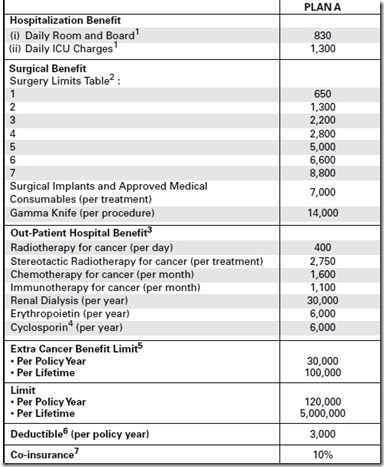
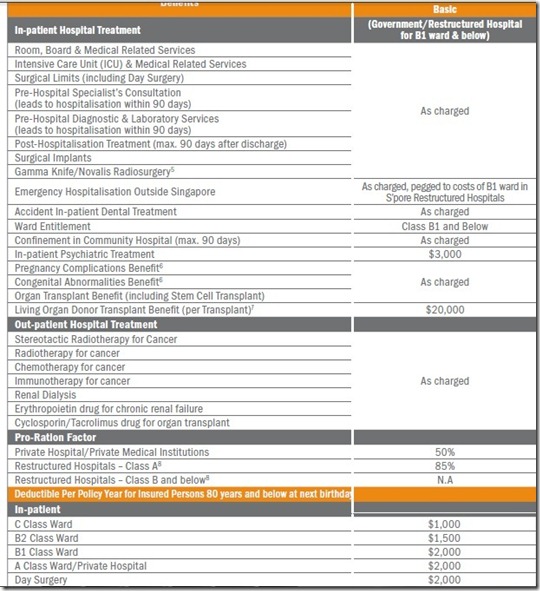

Now if I were to choose based on my first criterion, i.e. amount of in-patient coverage, and if I were to opt for a Class B1 ward (an air-con ward with four beds and an attached bathroom; B1 ward and above are considered non-subsidized ward), NTUC Basic Plan will pay as per charged, whereas AIA Plan A capped it at $830 per day in any ward or $1300 per day in ICU. But if I consider the surgical benefits, NTUC Basic Plan will pay as per charged, unlike AIA Plan A which has a cap limit.
Next, if I were to compare the out-patient treatment benefits, AIA Plan A cannot hold a candle at all to NTUC Basic Plan as the latter plan pays as per charged. AIA Plan A loses out by a wide margin in this category.
Lastly, if I were to compare the claim limit per policy year, AIA Plan A also loses out by another wide margin as well. AIA sets a cap limit of $120,000 per policy year, while NTUC Basic Plan sets $150,000. But for lifetime limit, there is no limit at all for NTUC Basic Plan, while AIA Plan A caps it at $5 million for lifetime.
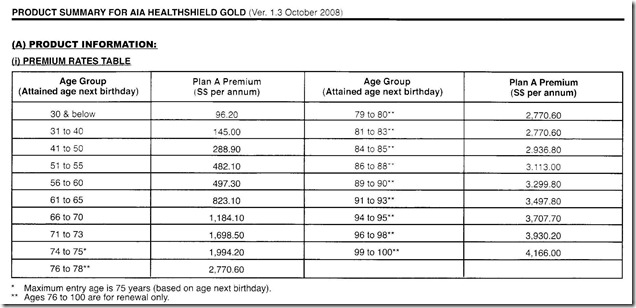
Now it is clear which is the winner. But if you think the premium for NTUC Basic Plan should cost at least twice AIA Plan A, here’s the truth.
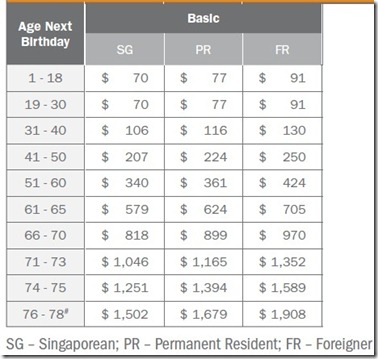 Premium Table for NTUC Enhanced IncomeShield Basic Plan
As I mentioned in the my previous blog entry, when one is scouting for health insurance policy, there are three criteria one should be comparing: 1) The amount of coverage during hospitalization; 2) The types of coverage after discharge, including out-patient treatment; 3) The claims limit per policy year and per lifetime. Let’s compare the benefits of AIA Plan A with NTUC Basic Plan.

AIA HealthShield Gold Plan A Benefits


NTUC Enhanced IncomeShield Basic Plan
Now if I were to choose based on my first criterion, i.e. amount of in-patient coverage, and if I were to opt for a Class B1 ward (an air-con ward with four beds and an attached bathroom; B1 ward and above are considered non-subsidized ward), NTUC Basic Plan will pay as per charged, whereas AIA Plan A capped it at $830 per day in any ward or $1300 per day in ICU. But if I consider the surgical benefits, NTUC Basic Plan will pay as per charged, unlike AIA Plan A which has a cap limit.
Next, if I were to compare the out-patient treatment benefits, AIA Plan A cannot hold a candle at all to NTUC Basic Plan as the latter plan pays as per charged. AIA Plan A loses out by a wide margin in this category.
Lastly, if I were to compare the claim limit per policy year, AIA Plan A also loses out by another wide margin as well. AIA sets a cap limit of $120,000 per policy year, while NTUC Basic Plan sets $150,000. But for lifetime limit, there is no limit at all for NTUC Basic Plan, while AIA Plan A caps it at $5 million for lifetime.
Now it is clear which is the winner. But if you think the premium for NTUC Basic Plan should cost at least twice AIA Plan A, here’s the truth.

Premium Table for AIA HealthShield Gold Plan A
 Premium Table for NTUC Enhanced IncomeShield Basic Plan
As you can see, if you are a Singaporean, you are paying a premium for NTUC Basic Plan at a price way below that of AIA Plan A. Even if you were a foreigner, it will still be cheaper if you were to purchase NTUC Basic Plan. In my previous blog entry, I have argued that if the premium is affordable for you, go for the NTUC Preferred Plan. In this blog entry, I am comparing the insurance policy I am holding now with NTUC Enhanced IncomeShield Basic Plan. It is very obvious which plan is more superior. I am disappointed that the insurance company which I have grown to trust so much is losing its edges, and is not revising its policy to maintain a competitive edge against other insurance companies.
I would like to urge the AIA management team to re-examine the policy their company is offering their clients. What matters at the end of the day is that their clients can afford quality healthcare services and the insurance company can be proud to claim that they have their clients at heart. It is critical for an insurance company to be willing to go all the way to enhance its reputation as a trustworthy insurance company who values clients as their core mission, rather than profits, because ultimately insurance company is dealing with human's lives. The insurance agents themselves will derive great satisfaction from meeting the real needs of humans rather than selling a package deal for commission, and this itself is a great source of motivation.
May AIA one day rise to the challenge of meeting real human needs rather than being focussed on commission, and may they set the standard which other insurance company will hold up to one day.
May AIA one day rise to the challenge of meeting real human needs rather than being focussed on commission, and may they set the standard which other insurance company will hold up to one day.
Subscribe to:
Posts (Atom)